

Helping your dog stay at a weight that’s suitable for their age, breed and size can help them live a long, happy and healthy life. Quite a lot of dogs weigh more than they should, so being able to check whether your dog’s in shape can help set your mind at ease, as well as making you aware early of any signs that they might need a change to their diet.
Body Condition Scoring (BCS) is a really helpful technique, which can help you quickly and easily assess your dog’s weight, by eye and by touch. This article will explain what BCS is, how vets use this technique and how you can use it at home to help you take care of your dog.
Key takeaways
- Body Condition Scoring can help you figure out at home whether your dog is underweight, overweight or just right.
- The health boost that comes with being an ideal weight makes it really important to stay aware of your dog’s body condition.
- Vets use Body Condition Scoring to track your dog’s health over time and any changes between appointments, especially if they have recently had a health condition that affects or is affected by their weight.
- To work out your dog’s Body Condition Score, follow the steps in this article to check their hips, belly and waist by eye and by running your hands over them – basically giving them a bit of a fuss, which many dogs love!
- Check out our Body Condition Score visual chart, but bear in mind that some breeds of dogs might have different characteristics, meaning that an ideal weight might look somewhat different for them.
- Carrying out a BCS test once a month will be often enough for most dogs, but you can do it every two weeks to track their weight and body condition more closely if they are on a diet, getting older or their activity level has recently changed.
Table of contents
What is Body Condition Score (BCS)?
Why Body Condition Score is important for your dog’s health
How vets use Body Condition Score
How to check your dog’s body condition
Body Condition Score chart for dogs
What each Body Condition Score means
How often should you check your dog’s body condition?
When to speak to your vet
What is Body Condition Score (BCS)?
Working out your dog’s Body Condition Score is a great way to check whether they’re a healthy weight. It doesn’t take long at all and involves checking your dog’s shape by having a close and careful look at them, and running your hands over their sides, back and stomach.
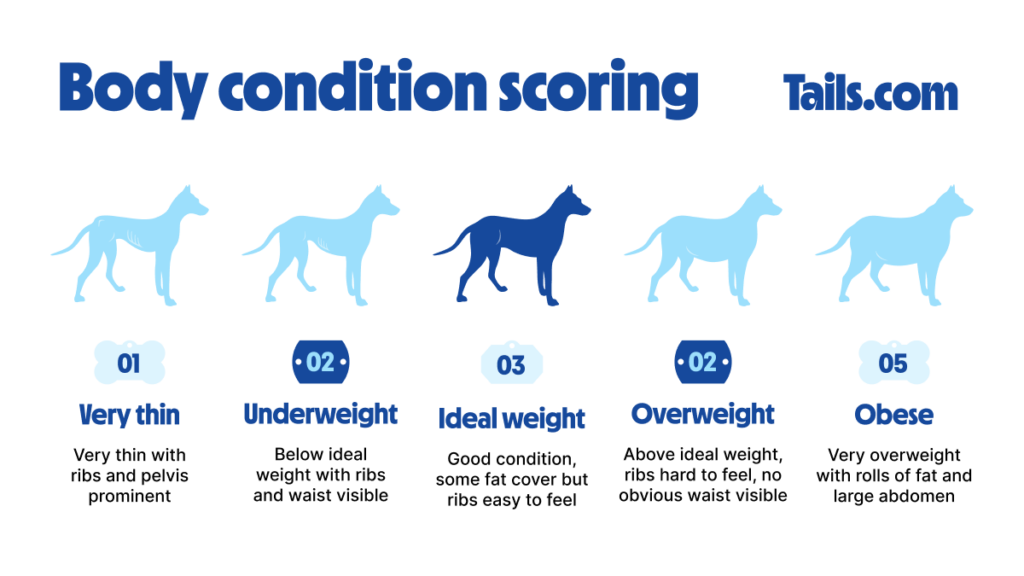
Some BCS guides measure from 1-9, but we’ll be using a simple 1-5 scale in this article, where 1 represents a dog who is much too thin and 5 represents a dog who is very overweight. What we’re looking for is a score of 3, right in the middle, which represents your dog’s ideal weight.
This technique is vet-approved, used all over the world and easy to carry out at home. You just might want to ask your vet to demonstrate it for you the first time you try, as if you’ve never carried out a BCS test before, it might feel tricky to know what to look for.
Why Body Condition Score is important for your dog’s health
It’s quite common for dogs to put on some excess weight, which might not always be noticeable at first glance. That’s one reason why Body Condition Scoring is so helpful, as by focusing on each step of the test, you can pick up any signs that your dog might be overweight.
It’s much better for dogs to be trim and fit than carrying excess weight, as dogs that are in good shape are much less likely to develop certain health conditions. [1] You can protect your dog’s health by noticing any changes to their body condition early, and taking steps to help them stay slim and lose any extra weight.
Here are a few of the health conditions to be mindful of, which overweight dogs are more likely to experience:
- Joint health: Increased pressure on dog’s joints can make them sore and stiff, as well as increasing the risk of them developing conditions like arthritis. In contrast, losing weight can actually help reduce lameness in dogs with osteoarthritis. [2]
Mobility: Dogs who are overweight might find it harder to move around and enjoy healthy exercise – which can present issues when trying to reduce their weight. Swimming is a great source of exercise for dogs who need to lose quite a bit of weight. - Heart health: Excess body weight can put strain on the heart and cardiovascular system. This can raise blood pressure and make it harder for the heart to pump oxygen around the body.
Regularly checking your dog’s Body Condition Score and being aware of their weight is a key part of helping prevent them developing health issues like these.
How vets use Body Condition Score
Vets use Body Condition Scoring alongside weight itself – you can’t always tell whether a dog is at the right size just based on their weight measurement. BCS helps your vet check whether dogs have a good balance of muscle to fat, however much they weigh on the scales.
BCS helps track trends over time, so vets can develop an understanding of how your dog’s doing in between visits. If you’ve recently changed your dog’s diet, your vet will be able to tell what effect it’s having. They’ll also be able to use this test to track your dog’s health if they have (or are recovering from) a medical condition that affects their weight, such as worms which can leave dogs too thin, or thyroid conditions which can in some cases contribute to excess weight gain.
Based on your dog’s Body Condition Score, your vet can give you up-to-date, personalised advice on feeding and exercise, helping you make sure your pup stays at a healthy weight. Every dog is different, so your dog’s ideal weight might be slightly above or below the average for their breed.
For more information on how to tell if a dog is at a healthy weight, you can read our guide ‘Is my dog overweight?’
How to check your dog’s body condition
By getting hands-on and assessing three key areas, you can work out if they’re underweight, overweight or in ideal condition. The three areas to examine and feel are:
- Ribs
- Belly
- Waist
Once you’ve assessed these three areas, you give them a score on a five-point scale:
1 = Severely underweight
2 = Underweight
3 = Ideal condition
4 = Overweight
5 = Obese
Feel your dog’s ribs
What to do
Run your fingers over your dog’s rib cage, on either side of their chest in a head to tail direction. To help you know what to look for, you can also use the ‘hand test’, comparing how your dog’s ribs feel to your hand in different positions – I’ll explain as we go along.
What should you feel, and how should it look?
You should be able to feel the ribs with a slight covering of muscle over them. But they shouldn’t feel like sharp ridges or be poking out. It’s important to really feel them with your fingertips rather than just looking, as many dogs’ coats will hide the ribs from view. Your dog’s ribs shouldn’t be too visible but for some dogs, seeing the last rib is normal at a healthy weight, especially if they are in movement or lying on their side. Very lean breeds like Whippets might also have ribs that are easier to see.
To use the hand test, a healthy dog’s ribs should feel a bit like your knuckles on the back of your hand when your hand is out flat – just under the surface of the skin.
Low body condition scoring
If your dog is underweight, their ribs will protrude and feel sharp or bumpy as you run your hands along them. If this is the case, it’ll mean a lower BCS. Let’s use the hand test again for another comparison. Make your hand into a fist and feel the knuckles – if your dog’s ribs stick out like this, they will have a low Body Condition Score, meaning they should ideally weigh a little more.
High body condition scoring
If your dog is overweight, the ribs will be difficult to feel as they will be covered in a layer of fat and muscle. The deeper the ribs are to feel under this layer, the more overweight your dog is and the higher the BCS. And to use the hand test once again, open your hand and turn it palm up – when you touch your knuckles now, they will be hard to feel. If your dog’s ribs feel like this, it’s a sign that they are carrying excess weight.
Check your dog’s waist from above
What to do
Look down on your dog’s waist and hips from above, and compare the width of their waist, hips, chest and rib cage.
What should you feel, and how should it look?
If your dog’s at a healthy weight, the shape of their waist should be clearly visible, with a slight hourglass shape. A slowly tapering abdomen leading from the wider chest to a narrow waist is the sign of ideal condition.
Low body condition scoring
An underweight dog will have a waist that is noticeably much narrower than their shoulders, ribs and hips. The bones of the hips and spine may be easily visible and can be felt protruding under the skin. The more pronounced these bony projections, the more underweight they are and the lower their BCS.
High body condition scoring
In overweight or obese dogs, the waist will be less clearly visible as it won’t narrow as much (if at all) towards the hips. This means for an overweight dog you might see a straight line instead of the slight hourglass you see in dogs at an ideal weight.
The trunk or abdomen will often be just as wide as the chest, giving them barrel-shaped appearance – the dog might even look rounded from above. In dogs with a very high BCS, there may even be fat pads at the waist which stick out even further than the width of the chest when viewed from above.
Look at your dog’s side profile
What to do
Run your hand along your dog’s underside, again from head to tail, and look at the shape of their belly from the side.
What should you feel, and how should it look?
The belly or undercarriage should start low to the ground where it meets the sternum (or breastbone) at the bottom of the rib cage. Then it should slope higher the further back towards the hips you run your hands on either side. You should be able to see a slight ‘tummy tuck’ because of this angle.
Low body condition scoring
An underweight dog with a lower BCS will have a very pronounced ‘tummy tuck’ up towards the hips and groin – the angle between their belly and ribcage will look steep and sharp. However, it’s worth noting that for some lean, deep-chested breeds of dogs like certain sighthounds, a steeper angle and more pronounced tuck is normal at a healthy weight.
High body condition scoring
If the belly droops or hangs down near the floor all the way along and doesn’t tuck up underneath the hips, then your dog may be carrying excess weight and have a higher BCS. They might also have a belly that seems to go straight across – just because it isn’t drooping down doesn’t mean the dog isn’t overweight. But a belly that droops down can be an indication that a dog is significantly overweight.
What each Body Condition Score means
Let’s quickly go over what each score might mean, and what that will tend to look like.
Underweight (BCS 1-2)
Although it’s more common for dogs to be overweight than underweight, this is still something to look out for, as it can affect their health in several ways. Dogs who are too thin because they aren’t getting the healthy nutrition they need might be low in energy, or have a less strong immune system. However, bear in mind that being a little on the lean side is quite healthy for a dog – what we really need to look out for is when dogs are much too underweight.
Key signs that your dog is underweight that a quick BCS test can reveal include:
- The bones of their ribs, hips and spine feel very prominent to the touch and might be clearly visible.
- From above, their waist looks much narrower than their shoulders, chest or hips – these bones might seem to stick out.
- Seen from the side, there’s an extremely steep angle from their ribs to their stomach (a sharp ‘tummy tuck’).
An underweight dog may also have a dull coat, if they aren’t getting enough vitamins, minerals, protein or healthy fats in their diet. However, dogs of any shape or size can have a dull coat, so just because you notice this sign doesn’t mean your dog needs to put on weight.
Ideal weight (BCS 3)
In contrast, here’s what you should see and feel when working out your dog’s Body Condition Score, if they’re a healthy weight – the gold standard. It’s worth bearing in mind that some breeds of dogs may have a slightly different shape or proportions. As well as asking your vet about what your dog’s ideal weight looks like, you might want to search online to see if there’s a BCS chart available that’s specific to your dog’s breed.
- When you touch your dog’s sides, their ribs should be fairly easy to feel, under a light covering of muscle – you should also be able to feel their hip bones and vertebrae. Their last rib might be visible under their skin, especially if they’re a lean breed like a Greyhound.
- Looking at the dog from above, they should have a slight hourglass shape, with a waist that’s distinctly narrower than their hips and chest.
- From the side, you’ll see their abdomen slopes up from their ribcage towards their hips.
Overweight and obese (BCS 4-5)
It’s increasingly common for dogs to weigh more than they should and it can be hard to know if you’re feeding your dog too much, meaning that dogs can easily cross the threshold into being overweight, even if they get plenty of exercise.
There are some health risks to this, which is why it’s so important to regularly check to make sure your dog doesn’t weigh too much. As we discussed briefly earlier, if dogs carry some excess weight, it can put strain on their joints, affect their heart health and increase the likelihood that they develop certain health conditions.
Here’s what to look out for:
- In an overweight dog, their ribs, hips and spine will be covered in a layer of fat that makes these bones difficult to feel under your hands.
- From above, the dog doesn’t have an hourglass shape – their body from shoulders to hips might have a straight line, or even curve outwards in a barrel shape.
- When seen from the side, the dog’s abdomen doesn’t visibly slope upwards towards the hips. It might even sag downwards.
Body Condition Score vs your dog’s weight
Knowing how much your dog weighs is important, but it isn’t the whole story. Their weight might sound fine on paper for a dog of their breed and size, but conducting a BCS test might show you that they’re actually not their ideal weight. Finding out their Body Condition Score by touch can help reveal their body composition, and whether they have enough muscle compared to fat – especially for dogs whose body shape is hard to see under lots of fur.
Dog breeds vary a great deal, and gaining a couple of kilograms will mean something very different for a tiny Bichon Frise than a big German Shepherd. Dogs with a large frame will obviously weigh a lot more, but there are also other factors that are different across breeds, such as whether they tend to be thickset and sturdy like Rottweilers, or whether they’re generally leaner, like Greyhounds. Body Condition Scoring will help you check quickly and easily if they’re fit, trim and healthy, whatever their size and shape. Just remember that because dog breeds have different body types, each dog’s ideal weight might look a little different. [3]
The BCS technique is more reliable for an everyday check than just popping your dog on the scales. While weight might fluctuate just after meals and so on, you’ll still be able to feel whether your dog’s ribs, spine and hips are covered with light muscle or a bit too much fat. However, you should also still weigh your dog regularly, especially if you’re tracking their progress as they get to a healthy weight – a Body Condition Score isn’t exact in the same way as a weight measurement.
How often should you check your dog’s body condition?
A monthly BCS check will be plenty for most dogs, but there are certain situations when you might want to check more frequently, such as every two weeks. If your dog’s diet has changed for any reason, you might want to check more often – you can see how they’re doing on their new food and whether they might need different portion sizes.
You might also want to check your dog’s Body Condition Score more frequently if your dog’s activity level has changed. This might be the case if they’re recovering from an injury or surgery and haven’t been able to get as much exercise. On the other hand, you might have started taking your dog on longer walks, jogging with them or having fun together with new dog agility exercises. Lastly, as your dog ages it’s very important to stay aware of their health. Older dogs can sometimes appear thinner because of losing some muscle mass as they age in a process called ‘sarcopenia’, which a BCS test can help you spot. [4] In their senior years, dogs can also be more likely to put on weight, if they’re less energetic than when they were younger while eating as much food as they did then. Senior dog food has different ingredients to support their health, as their dietary needs change as part of getting older.
When to speak to your vet
If you have any concerns about your dog’s weight or have any questions, your vet will be a great help – they’ll be able to advise you on what weight your dog should be and how to help them get there, if they’re over or under that size.
However, sometimes it’s especially important to talk to your vet about your dog’s weight. Here are a few reasons why you might look to make an appointment:
- Your dog’s Body Condition Score has suddenly changed – they have gained or lost a significant amount of weight.
- You’re not sure how to do a BCS test at home – your vet will show you how.
- Your dog has mobility issues, whether this is causing you to worry they might put on weight or lose muscle, or whether these issues have come from your dog being overweight.
- Your dog is persistently gaining or losing weight.
Conclusion: Using Body Condition Score to support long-term health
I hope this guide to Body Condition Scoring was helpful. This simple test is easy to carry out at home and you don’t need any special equipment to do it! It’s vet-approved and one of the most reliable ways to assess your dog’s weight, alongside getting them on the scales.
Regular BCS checks will help you identify any changes to your dog’s condition, whether these could be early signs of a health condition, or weight gain or loss that suggests they need a new diet or exercise plan. Even small changes can make a big difference over time, so that’s why it’s important to check often. Weight gain or loss can be so gradual that you don’t notice it at first, but keeping your dog at or close to their ideal weight is one of the best things you can do for their health.
FAQs:
What is a healthy Body Condition Score for dogs?
Ideally, on a 5 point scale like the one we’ve used here, you should be looking for a score of 3 – in the middle. If you’re using a 9 point scale which breaks down the weight categories further, you should be looking for a score of 4 or 5.
Can I check my dog’s Body Condition Score at home?
Yes, it’s easy to check your dog’s Body Condition Score. All you need to do is gently run your hands over your dog to feel their sides, back and belly, while assessing their body shape visually by looking at them from different angles. You might want a vet to show you how to do it the first time if you’re not sure, especially if your dog is a breed that looks different to other dogs because of having a stockier or leaner build, deeper chest or shorter limbs.
Is Body Condition Score better than weighing a dog?
BCS tests can be more revealing than weight measurements alone, as well as more reliable, because you learn about muscle as well as fat. You should also know how much your dog weighs though, especially because it’s easier to track changes over time using weight measurements.
How accurate is Body Condition Scoring?
Body Condition Scoring can be a really powerful tool, and it’s accurate, as long as the person carrying out the test knows what they’re looking for. Some studies have suggested that even when using Body Condition Scoring, people can still sometimes underestimate their dog’s weight and body size. [5] That’s why it can be so helpful to get your vet to run through it with you together.
Can puppies use Body Condition Scoring?Yes, you can use it to check your puppy’s body condition – just bear in mind that the way they grow isn’t linear. When they go through growth spurts, puppies can have phases where they look really lean. We’ve got more info in our puppy weight guide blog post including just how rapid their growth is, especially when they’re very young.
Sources
[1] ‘Pet obesity – causes, treatment and prevention’, RSPCA
[2] ‘The effect of weight loss on lameness in obese dogs with osteoarthritis’, Veterinary Research Communications, 17 March 2010
[3] ‘Effect of breed on body composition and comparison between various methods to estimate body composition in dogs’, Research in Veterinary Science, 18 August 2009
[4] ‘Sarcopenia in dogs’, PetMD, 20 August 2025
[5] ‘Owner misperception of canine body condition persists despite use of a body condition score chart’, Journal of Nutritional Science, 8 October 2014